

ElectronicFrog
A consumer electronics trade-in service that paid cash for used devices
- Years active
- 2007-2014
- Status
- Temporarily dormant
- Confidence
- Verified in a primary document or official record
ElectronicFrog, also styled eFrog, was a consumer electronics trade-in service. Archived captures describe a business that let people sell old electronics such as cell phones, tablets and e-readers for cash. A customer requested a quote online, then either dropped the device off in the Asheville area or mailed it in. Its logo was a green cartoon frog on a lily pad, drawn with circuit-trace detailing.
The operation ran alongside Boost Liquidation on shared facilities and shared staff, one early instance of a pattern that runs through the whole record: from the earliest years, multiple brands ran on one shared operation.
eFrog outlived Boost. It was the durable half of the electronics operation because it required no inventory purchasing: customers brought the inventory in and were paid on receipt.
Company records date the brand's establishment under Lake Holdings to 2007, while archived captures of electronicfrog.com run from 2003 to 2014. The two records disagree about when the brand began. The recovered mark carries ELECTRONICFROG.COM branding and is likely from a later version of the site than the earliest captures.
The strategic point
Why it mattered
ElectronicFrog is the most underappreciated brand in the early record. It was a reverse-commerce intake business, the consumer-facing mirror image of what Boost Liquidation would later attempt at wholesale. eFrog acquired used electronics one device at a time from individuals. Boost acquired returned goods by the truckload. They are the retail and the wholesale ends of a single competence, which is assessing the condition and the residual value of secondhand hard goods.
The difference between them is the balance sheet, and the balance sheet decided which one survived. Boost had to buy inventory before it could sell any, which is why outside financing became the condition of its expansion. eFrog was paid to receive inventory. When the Boost warehouse was cleared in March 2013, eFrog was still running, and archived captures of the site continue into 2014.
The same lesson is drawn again more than a decade later. After Hurricane Helene, the stated strategy is a capital-light rebuild, which in this particular history is not a new idea but a return to a principle the company had already paid for once: the businesses that break are the ones that must buy inventory before they can sell it.

Archive
Screen capture
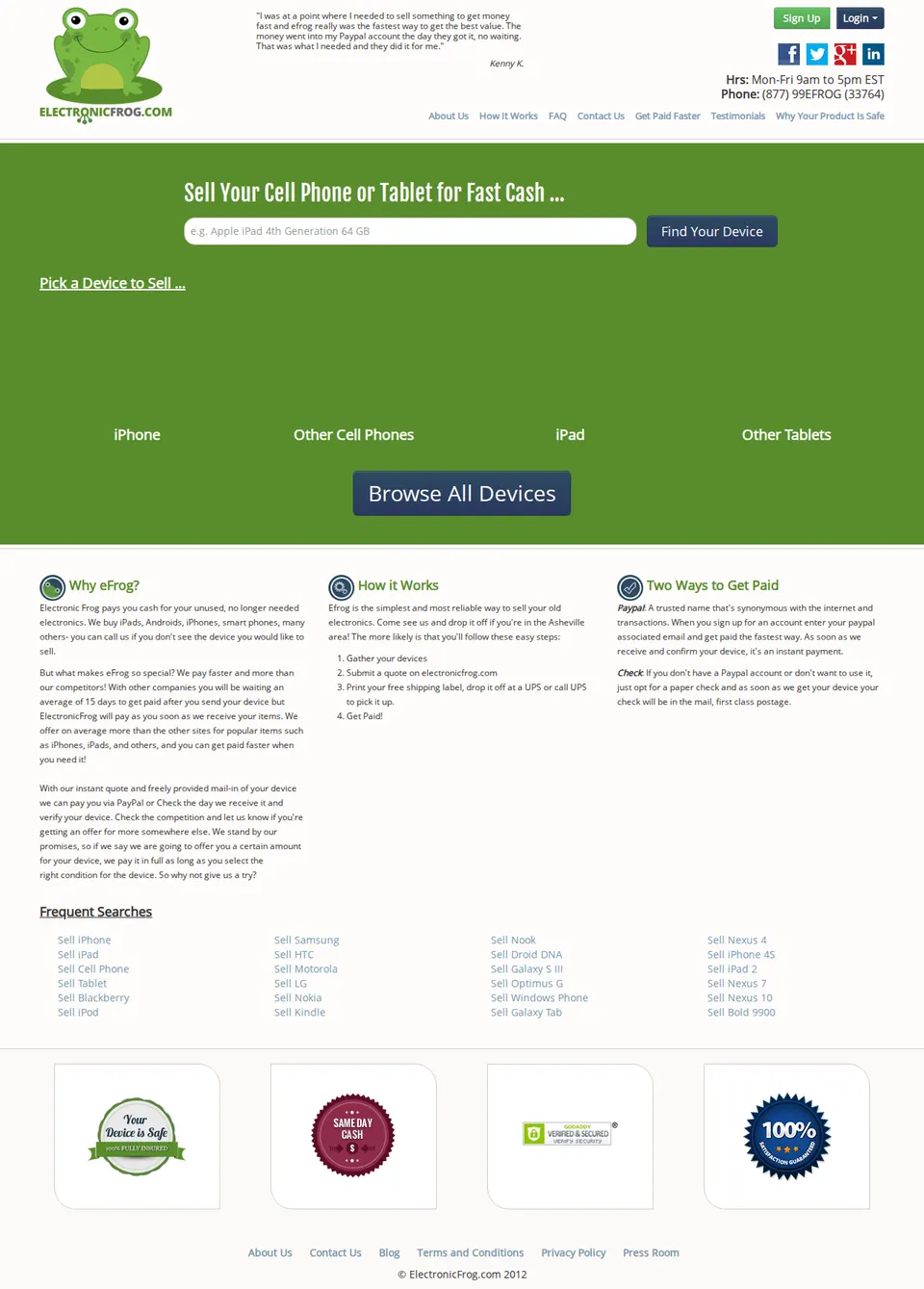
The electronicfrog.com homepage in 2013, setting out the online quote, the Asheville drop-off and the mail-in options for used devices.
Reference
The record
- Portfolio group
- Legacy record
- Years active
- 2007-2014
- Status
- Temporarily dormant
- Confidence
- Verified in a primary document or official record
- Domain
- electronicfrog.com
- Mark source
- Recovered from an archived capture, 2013
- Mark dimensions
- 183 × 162 pixels