

Boost Liquidation
Revolutionizing the Liquidation Industry
Item-level B2C resale of Amazon customer returns, tested and graded one piece at a time
- Era
- Goods
- Years active
- 2011-2014
- Status
- Dissolved
- Confidence
- Verified in a primary document or official record
Boost Liquidation bought Amazon customer returns by the truckload, tested and graded them item by item, and resold them individually rather than flipping them by the pallet to other liquidators. The thesis was that customer returns, tested and classified one piece at a time, could be sold individually B2C instead of B2B, opening a market the pallet-flippers were leaving untouched. The tagline printed on the logo was Revolutionizing the Liquidation Industry. The public positioning was more modest and more accurate: a liquidation resource for retailers, eBay sellers, flea marketers and craigslisters, specializing in customer returns and wholesale closeouts. Archived snapshots list Maddison Lake as president.
The model was measured honestly in the company's own records, including its losses. A meaningful share of what arrived on every truckload was unrecoverable before any labor was applied, and only a small fraction arrived new in box. Those measurements sat in the middle of the company's own expansion planning rather than in a footnote, where a less rigorous operator would have buried them.
In 2012 the company sought outside capital to scale the model, and the capital never arrived. In March 2013 it wound the operation down in public view, selling its own pallet shelving, its forklift and a company car in a going-out-of-business sale advertised with television spots, balloons and an inflatable arm man. The B2C thesis that had justified the entire enterprise ended by reverting to the physical storefront model Boost had been created to escape.
The operating dates and the legal dates do not match. Archived captures of boostliquidation.com show the business trading well before Boost Liquidation, LLC was formed on October 31, 2012, and the entity was dissolved on March 6, 2014. For most of its operating life Boost ran as a trade name or division inside another entity rather than as its own limited liability company.
The strategic point
Why it mattered
Boost Liquidation, LLC was formed on October 31, 2012 and dissolved on March 6, 2014, both recorded in the public state filing index. The entity is younger on paper than the business was in practice: archived captures of boostliquidation.com show the brand trading well before the filing.
The dissolution deserves to be stated precisely, because it is the part of the story that is easy to miss. It was voluntary, filed and paid for, rather than an administrative dissolution for unfiled reports, which is the ordinary fate of an abandoned company. The winding down was public and orderly, and the entity was then closed properly and deliberately.
The venture also documents the limit of the model. Item-level resale of customer returns is labor-heavy and inventory-heavy at once, and scaling it required outside capital. The company sought that capital and did not raise it, and without it the thesis could not outrun its cost structure. Recording that plainly, rather than softening it, is what earns the rest of this history its credibility.
Cross references
Related brands
-
Its inventory platform was first prototyped as Toys Liquidators.
-
Applied the research method of Storage Unit Auction List.
-
Grew out of the liquidated-goods sourcing at WNC Appliance.
-
Wholesale mirror of the consumer trade-in business ElectronicFrog.
-
Sourcing knowledge repackaged as a subscription by Inventory Scouts.
-
Parent operation behind the kiosk concept Liquidation Station.
-
Engineering capability later productized as DevHouze.




Archive
Screen capture
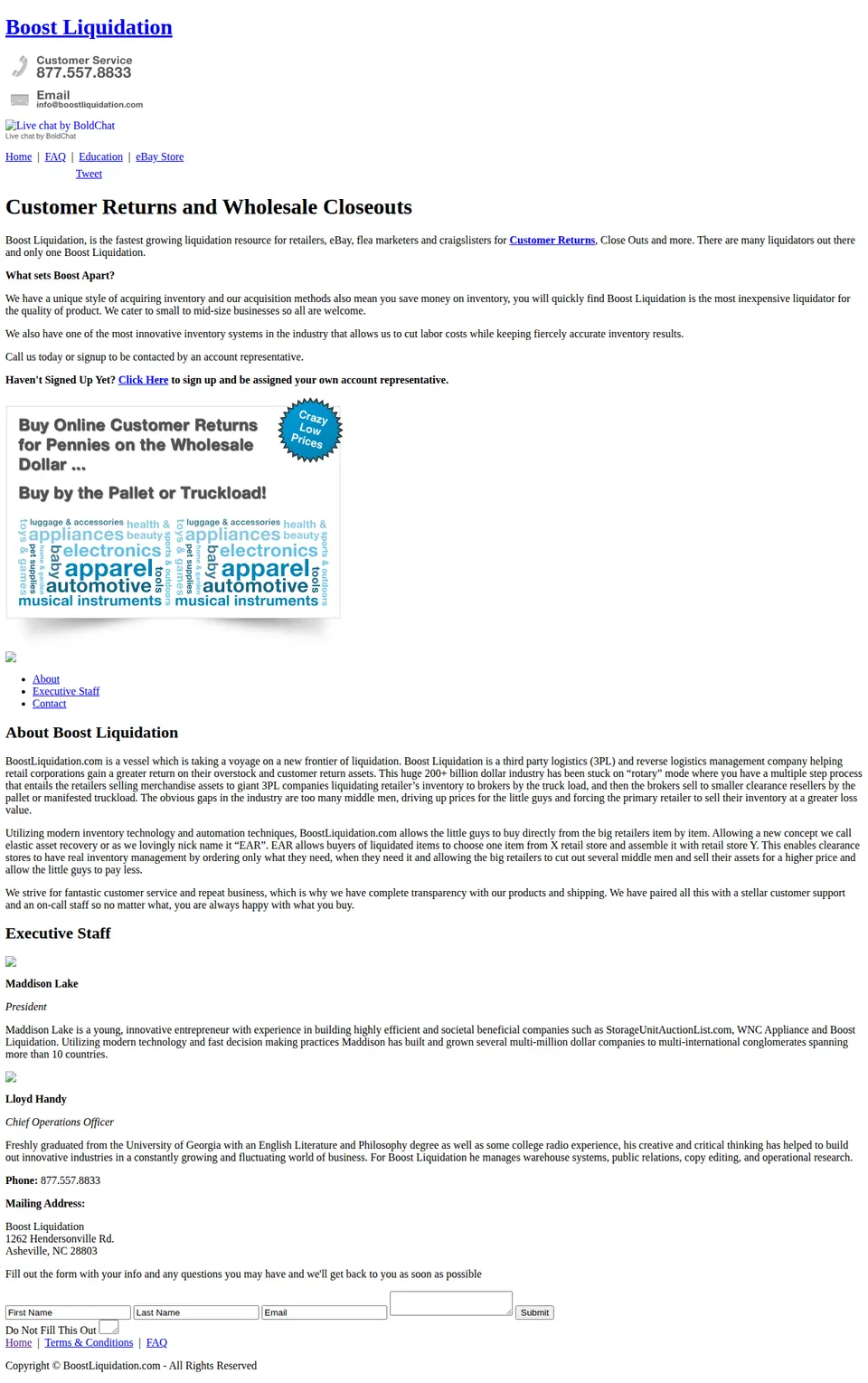
boostliquidation.com as captured by the Internet Archive on May 3, 2012.
Reference
The record
- Portfolio group
- Legacy record
- Years active
- 2011-2014
- Status
- Dissolved
- Confidence
- Verified in a primary document or official record
- Domain
- boostliquidation.com
- Mark source
- Recovered from an archived capture, 2012
- Mark dimensions
- 245 × 100 pixels